
How to Set Up a Kawaii Finance Journal (Real Spread Inside)
A step-by-step guide to building a budget journal with kawaii stickers — featuring a real June 2026 finance spread using stickers from stickerpacks.
Why your budget journal should be cute
Budgeting gets a bad reputation for being stressful, number-heavy, and joyless. But it doesn't have to be. A kawaii finance journal turns your monthly money check-in from something you dread into something you actually look forward to — complete with pastel stickers, soft color palettes, and little illustrated victories every time you hit a savings milestone.
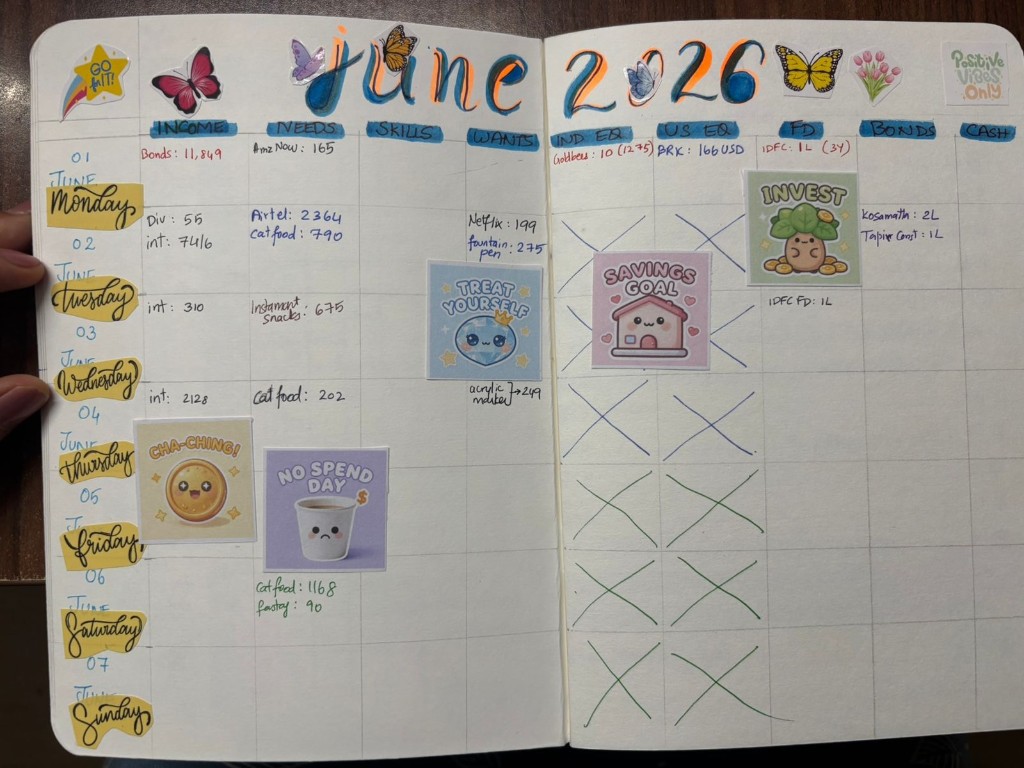
The cover photo of this post is a real June 2026 finance spread using stickers from this very site. You can see the Cha-ching, No Spend Day, Savings Goal, and Invest stickers in action — marking actual wins and tracking real numbers in a hand-drawn monthly budget layout. It's proof that functional and adorable aren't mutually exclusive.
Here's how to set up yours from scratch.
What goes in a kawaii finance journal
A finance journal isn't just a place to log numbers — it's a space to build awareness and intention around money. A solid kawaii finance setup typically includes:
- Monthly budget overview — income, fixed expenses, variable expenses, and what's left
- Savings tracker — a visual goal bar or grid to color in as you save
- No-spend day tracker — a monthly calendar where you mark the days you spent nothing
- Debt payoff log — a thermometer or progress bar for each debt
- Investment notes — a simple log of what you invested this month and any thoughts on it
- Wins page — sticker-decorated records of money goals you hit
Each of these sections gets its own sticker category, color code, and layout — making the whole journal feel like a cohesive, beautiful system rather than a pile of spreadsheet printouts.
Choosing your finance sticker packs
The right stickers make a finance journal feel intentional rather than random. Here are the packs built specifically for money tracking:
- Money Basics — the essential first pack. 20 stickers covering bills paid, debt-free, savings goal, budget win, cha-ching and more. These are the everyday workhorses of a finance journal.
- Money Moves — for the bigger-picture financial goals: passive income, student loan payoff, emergency fund, and future-me milestones. Use these for your long-term tracker pages.
- Blueberry Finance — an adorable round blueberry character stars in this set of 20 budget stickers. Great for monthly covers and savings page headers.
- Mango Finance — the same 20 finance stickers in a warm golden mango colorway. Pairs beautifully with a cream-and-peach palette.
- Stock Market Kawaii — 20 investing stickers: bull run, bear market, hold, gains, profit, research. Perfect for an investment journal page or a trading notes section.
A good starting setup: use Money Basics for day-to-day tracking, Money Moves for the goal-setting pages, and one of the character packs (blueberry or mango) for monthly covers based on which color palette you're using that month.
Setting up your monthly budget page
The layout
Divide your page into four quadrants:
- Income — list every income source and total
- Fixed expenses — rent, subscriptions, loan payments — things that don't change
- Variable expenses — groceries, eating out, shopping — things you control
- Remaining / savings — what's left after everything is accounted for
Use a different sticker to mark each category. A "bills paid" sticker from Money Basics next to fixed expenses that you've confirmed paid gives a satisfying visual signal. A savings goal sticker beside your remaining balance makes it feel like a mini-celebration rather than just a number.
Color coding
Pick one color per category and use it consistently. A simple system:
- Green = income
- Pink = fixed expenses
- Purple = variable expenses
- Yellow/gold = savings and investments
Your stickers and your pen colors should match. This makes the page scannable at a glance — you know immediately what kind of entry you're reading.
The no-spend day tracker
This is one of the most motivating pages in any finance journal. Draw a simple monthly calendar grid (or use a template), and mark each no-spend day with a special sticker.
A "No Spend Day" sticker from the Money Basics pack is perfect here — you get a little illustrated reward every time you make it through a day without opening your wallet. By the end of the month, seeing a calendar dotted with stickers is genuinely satisfying.
Aim for 10–15 no-spend days per month as a starting target. Track it over 3–4 months and you'll start to see patterns in when and why you spend.
Your savings goal tracker
A visual savings tracker is the single most motivating element in a finance journal. The concept is simple: draw a shape (a jar, a thermometer, a heart, a bar chart) and divide it into segments representing your savings goal. Color in a segment each time you add money toward the goal.
Add a "Savings Goal" sticker at the top of the page, your target amount, and your current amount. Update it every time you transfer money to savings.
For big goals (emergency fund, travel savings, down payment), use the milestones approach: break the total into five equal milestones, and add a sticker or color block at each one. Milestone celebrations feel huge even when the total goal is intimidating.
Making it a habit
The most important thing about a finance journal isn't the layout — it's consistency. Here's a simple ritual that works:
Weekly (5 minutes): Log every transaction from the week. Mark any no-spend days. Check your budget overview balance.
Monthly (20 minutes): Set up next month's pages, review last month's numbers, update savings and debt trackers, and celebrate any wins with a good sticker.
The kawaii aesthetic is actually a helpful habit-formation tool here — when your journal is cute and you're proud of how it looks, you're more likely to open it regularly.
You might also enjoy
- Kawaii Journaling 101 — start with the basics before adding finance pages
- Printing Stickers at Home Without the Headache — print your finance sticker packs at home